
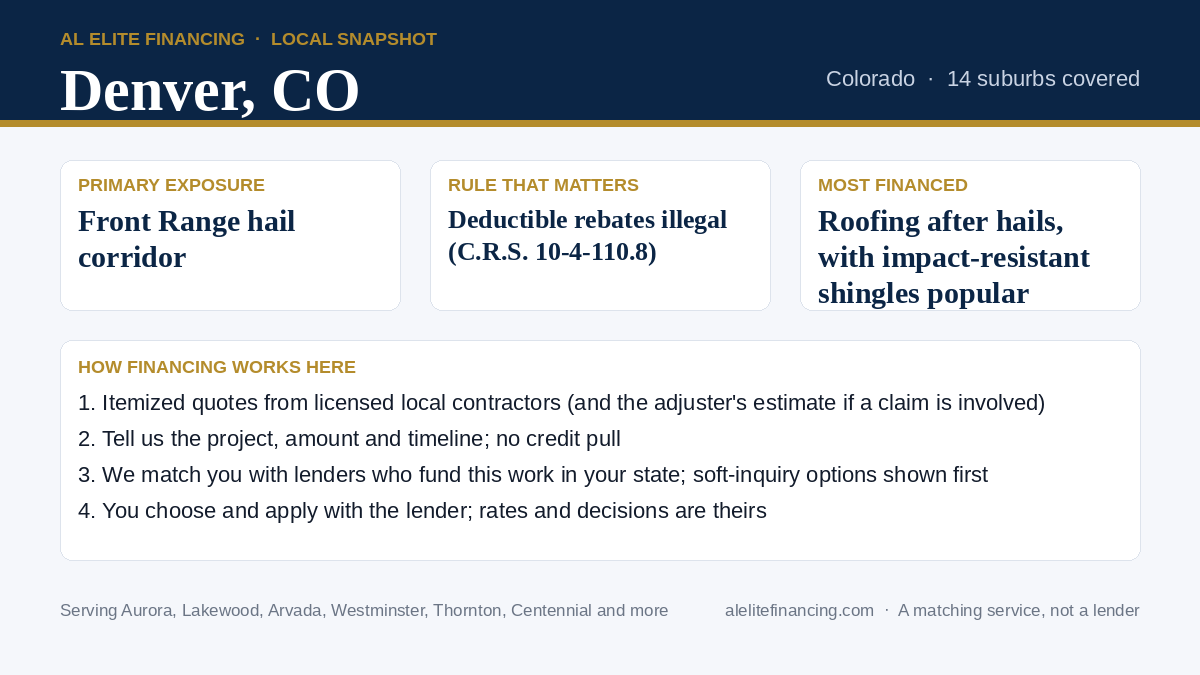
Financing home projects in Denver
Denver's Front Range is one of the most hail-exposed corridors in the United States, with late-spring and summer storms that have produced some of the costliest hail events on record. Colorado law prohibits contractors from waiving or rebating deductibles and gives homeowners cancellation rights if a claim is denied, so the financing conversation here is unusually well defined: finance the deductible and any uncovered items, legally, and compare the roofer's plan with your own loan.
This guide covers the Denver metro. For statewide rules, rebates and the other metros we serve, see roof, HVAC and home improvement financing in Colorado.
Denver's housing runs from Victorian and early-1900s homes in the central neighborhoods to 1950s to 1970s ranches in Lakewood, Arvada and Aurora and large 1990s-onward subdivisions in Highlands Ranch, Parker and Castle Rock. High altitude sun degrades shingles and exterior finishes faster than at sea level.
Suburbs and communities we serve around Denver
Lenders in our network fund projects across the Denver metro, not only inside the city limits. Homeowners and contractors in Aurora, Lakewood, Arvada, Westminster, Thornton, Centennial, Littleton, Highlands Ranch, Parker, Broomfield, Castle Rock, Englewood, Golden and Commerce City get the same matching, the same disclosures and the same Colorado lender coverage. If your community isn't listed, it's still covered; the list is the places we hear from most.
Roof financing in Denver: roofing companies that finance and how to compare them
Most established Denver roofers offer financing or monthly payment plans, almost always through a lender partner rather than their own money. Ask three things when you call for quotes: do you offer financing, through which lender, and does the pre-qualification use a soft credit pull. Get the full price in writing before the plan is discussed so you can see whether it changes, and ask what the price is for cash. If a good local roofer doesn't offer a plan, an unsecured loan arranged through AL Elite pays any roofer like cash. In Colorado, never accept an offer to waive or absorb your insurance deductible; finance it instead. Our guide to roofing companies that finance has the eight questions to ask, and HVAC companies that offer financing covers the same for AC and furnace work in Denver.
Why roofs in Denver get replaced early
Roofs in Denver are replaced early because of hail and wind. Colorado was among the top states for hail claim payouts in 2025, and the Front Range sees frequent large hail events. In 2025 State Farm alone paid out $5.6 billion in hail claims nationally, with Texas the largest state at $1.4 billion, followed by Missouri and Illinois (Claims Journal, April 2026). After a major event, every roofer in the metro is booked for months, prices rise and insurers slow down. The homeowners who get their roof done first are the ones who can fund the deductible and the gap without waiting on the check.
Many Front Range insurers now use roof-age schedules or separate wind/hail deductibles, which increases what homeowners finance. Denver's late-spring and summer hail season regularly produces large claim events.
Financing a roof, HVAC or home project in Colorado: local costs and rules
Colorado's Front Range is one of the most hail-exposed corridors in the country, and Colorado law (C.R.S. 10-4-110.8) prohibits roofing contractors from paying, waiving or rebating a homeowner's insurance deductible. The same statute gives homeowners the right to cancel a roofing contract if the claim is denied. Impact-resistant shingles are popular here because many insurers offer premium discounts for them; ask your agent before choosing materials, since the discount can offset part of the higher cost over the roof's life. Percentage deductibles are common on wind and hail coverage.
The same lenders fund the rest of the house. If the project is a kitchen, a fence, a generator, siding, windows or a water heater rather than a roof, our home improvement financing page covers every project type, and HVAC financing covers AC, furnace and heat pump replacements.
Two things apply to every Denver roof. First, roof prices vary with size, pitch, layers to remove, material and local labor, so two or three itemized quotes on the same scope tell you more than any average. Second, check the contractor before the loan: a current state license or registration where one exists, proof of insurance, a local address and reviews that predate the storm. The Federal Trade Commission's guide to hiring a contractor lists the warning signs. Our roof financing page compares the loan types, and our guide to roof financing after hail damage walks through a claim step by step.
How home improvement financing works in Denver
- Get itemized quotes from licensed Denver roofers. If there's a claim, get the adjuster's estimate too, so you know the gap.
- Tell us about the roof. Amount, timeline, whether insurance is involved, your state. No credit pull.
- We match you with lenders in our network who fund roofing in Colorado, and show you which start with a soft inquiry.
- You choose and apply with the lender. Rates, terms and the decision are theirs. Compare the offers and keep your roofer on schedule.
HVAC financing in Denver: AC, furnace and heat pump replacement
Roofing after hail leads, with impact-resistant shingles popular because of insurer discounts. HVAC (including heat pumps and evaporative-to-refrigerated conversions), windows, siding and fences follow. Solar is common.
HVAC replacements in Denver are usually decided in a day, when a system fails in the worst weather, so most are financed at the quote through the contractor's plan or an unsecured loan. Ask for two system options with the monthly payment on each, check utility rebates for high-efficiency equipment before you finance, and ask whether a promotional rate is deferred interest. If your credit is on the lower side, start with a soft-pull pre-qualification; see HVAC financing with bad credit. Our HVAC financing page compares the options, and the HVAC financing calculator runs your quote.
Home improvement loans in Denver: kitchens, bathrooms, fences, decks and windows
Planned projects in Denver follow the housing stock described above: renovations in the older neighborhoods, first replacements in the newer suburbs. The same four routes cover nearly every job: an unsecured home improvement loan (days to fund, no lien), the contractor's financing plan, a home equity loan or HELOC for large remodels if you have equity and a few weeks, and government-backed programs such as FHA Title I for eligible repairs. Start from the project page that matches yours: kitchen remodel financing, bathroom remodel financing, fence financing, deck financing, window financing, siding financing or flooring financing. Each has example payments and the questions to ask a lender.
Generator, foundation, plumbing and water heater financing in Denver
These are the projects that arrive without warning. Standby generators are financed before and after outages (generator financing, and our generator sizing calculator estimates the size and cost). Foundation repair is rarely covered by insurance and is usually financed in full (foundation repair financing). Water heater and sewer line failures are same-day decisions where short terms keep interest low (water heater financing, plumbing financing). For Denver homeowners considering solar or a pool, see solar financing and pool financing.
The same lenders fund HVAC replacement, siding and gutters (often damaged in the same storm as the roof), standby generators and other home improvements. If a storm took the roof and the AC condenser together, tell us both; one loan is simpler than two.
Contractor financing in Denver: customer financing and business loans for local trades
Denver has a mature roofing market with strong consumer protections. Contractors who present financing transparently alongside the claim process close more storm work.
Roofers, HVAC companies, remodelers, fence, foundation and plumbing contractors in Denver can offer customer financing at the estimate through our partner program (the lender pays you on completion; standard-rate plans usually cost you nothing) and get matched with business lenders for equipment, working capital and invoice factoring. See contractor financing programs and our guide to why contractors lose jobs without financing.
Storm season is when Denver contractors win or lose the year. Partner contractors offer customer financing at the kitchen table (paid at completion, deductibles handled legally) and get matched with business lenders for working capital, dump trucks and equipment. See offering financing to customers.
Frequently asked questions
Can I get roof financing in Denver?
Yes. Denver homeowners finance roofs through unsecured personal loans, contractor-arranged payment plans and home equity products. AL Elite matches you with lenders who fund roofing in Colorado. Submitting a request does not pull your credit.
Can I finance my insurance deductible for a roof in Denver?
Yes, through legitimate third-party financing. What a contractor cannot do is waive, absorb or rebate the deductible; that's illegal in many states and prohibited for AL Elite partner contractors. Financing covers the deductible and any upgrades or non-covered work; the claim covers the rest.
How much does a new roof cost in Denver?
It depends on size, pitch, material, tear-off and local demand, which spikes after storms. Get at least two itemized quotes from licensed Denver roofers. Our roof financing page explains the cost drivers and the calculator turns a quote into a monthly figure.
Can I get HVAC financing in Denver with bad credit?
Often, yes. Lenders in our network that fund HVAC work in Colorado include some that consider lower scores; start with a soft-pull pre-qualification, reduce the amount with rebates or a standard-efficiency system, and consider a co-applicant. Avoid 'no credit check' offers.
How do Denver contractors offer financing to customers?
By joining a program such as AL Elite's partner program: the homeowner applies at the estimate, the lender approves and pays the contractor on completion, and standard-rate plans usually cost the contractor nothing. Setup takes days to a few weeks.
Can I get home improvement financing in Denver for a kitchen, fence or generator?
Yes. The same lenders that fund roofs in Colorado fund kitchens, bathrooms, fences, generators, foundation repair, siding, windows, water heaters, solar and pools. Tell us the project and the amount and we match you with lenders who fund that type of work in Colorado.
Do you serve the suburbs around Denver?
Yes. Aurora, Lakewood, Arvada, Westminster, Thornton, Centennial, Littleton, Highlands Ranch, Parker, Broomfield, Castle Rock, Englewood, Golden and Commerce City and the rest of the Denver metro are covered; lender availability is set by state, not by city limits.
Does AL Elite have an office in Denver?
AL Elite matches Denver homeowners and contractors with lenders online and by phone.
I'm a roofer in Denver. Can I offer financing to customers?
Yes. Licensed, insured Denver roofers and HVAC contractors can join AL Elite's partner program to offer customer financing and be listed on this page. See financing for roofing companies.
Sources and further reading
Primary sources we rely on for this page. Program rules change, so check the source before you rely on a figure.