
Home projects in Utah: what gets financed and why
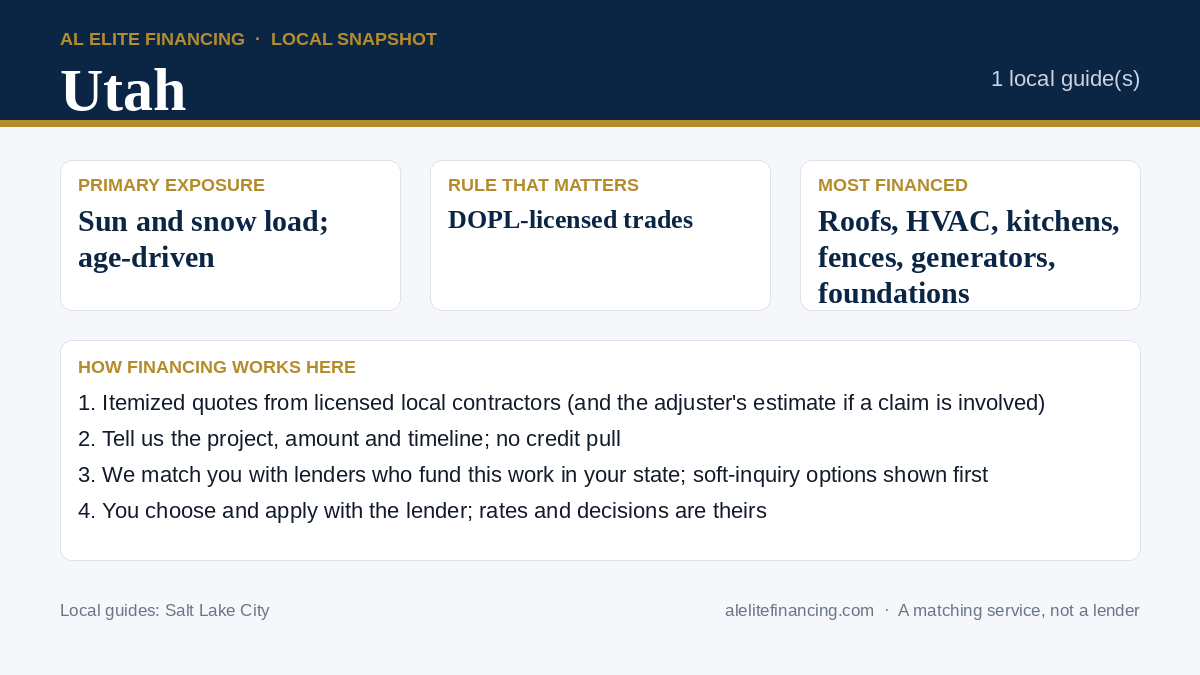
Utah roofs see less hail than the Plains but take heavy snow loads, intense high-altitude sun and wind, and most replacements here are age-driven rather than claim-driven. That means financing the full job, so comparing total cost across an unsecured loan, a contractor plan and a home equity product matters more than in storm markets. The dry climate makes evaporative-to-refrigerated AC conversions and high-efficiency furnaces common projects, and solar is popular along the Wasatch Front.
Roof financing, roof replacement financing and roof repair financing in Utah
Whether the search is for roof financing, roof replacement financing or roof repair financing in Utah, the loan products are the same: unsecured roof loans, contractor plans and home equity products. What changes is the amount: a repair is a short loan, a replacement after a claim is usually the deductible and uncovered items, and an age-driven replacement without a claim is the full job. The same lenders also fund HVAC, kitchens, fences, generators and the rest of the house across Utah; lender availability is set at the state level, so every town in Utah gets the same matching as the metros below.
Local guides for Utah
Utah rules that affect your project and your financing
Utah licenses contractors through the Division of Occupational and Professional Licensing, including roofing, HVAC, plumbing and electrical. Insurance claims are less central than in storm states; replacement-cost versus actual-cash-value still matters for older roofs.
Rebates, assistance and government-backed programs in Utah
Rocky Mountain Power and Dominion Energy offer rebates on efficient HVAC, water heaters and insulation. Weatherization runs through the Utah Department of Workforce Services. FHA Title I and USDA Section 504 apply for eligible homeowners. Links to the federal programs are in the sources at the end of this page.
Insurance claims in Utah: how the gap gets financed
Utah roofs see less hail than the Plains but take heavy snow loads, intense sun and wind, and many replacements here are age-driven rather than claim-driven. That means financing the full job, so comparing total cost across an unsecured loan, a contractor plan and a home equity product matters more than in storm markets. Utah's dry climate makes high-efficiency AC and evaporative-to-refrigerated conversions common HVAC projects, and local utility rebates can reduce what you finance.
When a claim pays most of a roof, siding or fence, the financing question is the gap: the deductible, depreciation held back until completion, and items the adjuster didn't allow. That is usually a smaller, shorter loan than the whole project. Our guide to roof financing after hail damage walks through the arithmetic, and the insurance and roof replacement guide covers policy language.
Financing options Utah homeowners use
- Unsecured personal loans. Days to fund, no lien, fixed rate. The most common route for roofs, HVAC, fences and generators.
- Contractor financing plans. A monthly figure next to the quote through the contractor's lender partner; ask whether promotional rates are deferred interest and whether the price is the same for cash.
- Home equity loans and HELOCs. Lower rates for large planned projects such as kitchens or whole-house siding, with weeks to close and a lien on the home.
- Government-backed programs. FHA Title I property improvement loans through HUD-approved lenders, FHA 203(k) for remodels folded into a mortgage, and USDA Section 504 repair loans and grants in eligible rural parts of Utah.
- Rebates and assistance. Utility rebates reduce what you finance on HVAC and insulation; weatherization assistance covers eligible households.
Financing by project type in Utah
Timing projects in Utah
Storm-driven work (roofs, siding, fences, gutters) peaks right after severe weather, when the best local contractors are booked for weeks and out-of-town crews arrive. Planned work (kitchens, bathrooms, windows, generators, water heater upgrades) is easiest to schedule in the shoulder seasons when crews have capacity and quotes are more competitive. Either way, arranging financing before you sign keeps the project on schedule: a pre-qualification that uses a soft credit inquiry costs nothing and tells you what you're likely to be offered before the deposit is due.
What lenders look at for Utah homeowners
Unsecured home improvement loans are approved on five things: your credit score and recent payment history, your income and how much of it already goes to debt, the amount requested, how long you've had credit, and a complete application. Reducing the amount (rebates, a smaller scope, a down payment), paying a card balance down before applying, having pay stubs or bank statements ready, and checking options with a soft pull before any hard inquiry improve offers at every lender. Home equity products add an appraisal and a required equity cushion, commonly 15% to 20% of the home's value.
How it works
- Get itemized quotes from licensed Utah contractors. If insurance is involved, get the adjuster's estimate so you know the gap.
- Tell us about the project. Amount, timeline, whether insurance is involved, your state. No credit pull.
- We match you with lenders who fund that type of work in Utah, and show which start with a soft inquiry.
- You choose and apply with the lender. Rates, terms and the decision are theirs.
For Utah contractors
Roofers, HVAC companies, remodelers, fence and foundation contractors across Utah can offer customer financing at the estimate (paid at completion, deductibles handled legally where claims are involved) and get matched with business lenders for equipment, working capital and factoring. See for contractors.
Home improvement financing in other states
- Texas
- Oklahoma
- Colorado
- Missouri
- Kansas
- Nebraska
- Indiana
- Minnesota
- Florida
- Tennessee
- Arizona
- Georgia
- North Carolina
- Illinois
- Ohio
- Pennsylvania
Frequently asked questions
Can I get roof financing anywhere in Utah?
Yes. Lender availability is set by state, so homeowners anywhere in Utah get the same matching, whether they're in Salt Lake City or a smaller town. Our local pages cover the metros we hear from most.
Which home projects can be financed in Utah?
Roofs, HVAC, kitchens, bathrooms, fences, generators, foundation repair, siding, windows, water heaters, plumbing, solar, decks and pools. Tell us the project and amount and we match you with lenders who fund that work in Utah.
Can Utah contractors offer financing to customers?
Yes. Licensed, insured Utah roofers, HVAC companies, remodelers and other trades can join our partner program to offer customer financing and get matched with business lenders. See for contractors.
Does AL Elite have offices in Utah?
AL Elite matches homeowners and contractors online and by phone across the United States.
Sources and further reading
Primary sources we rely on for this page. Program rules change, so check the source before you rely on a figure.